October's Surprises Across Quinte Markets
Canada's 2026 Federal Budget: Three Major
Changes to the Real Estate Market
The Canadian government released its 2026 federal budget on November 5, outlining several significant housing initiatives aimed at increasing residential construction, attracting investment and improving access to development financing.
Among the announcements are a proposed exemption to Canada's foreign buyer ban, expanded mortgage insurance for smaller multi-residential properties and nearly $45 billion in housing-related commitments. While these measures could encourage new construction, their impact on Canada's existing resale housing market may be considerably more limited.
Here are three of the most important developments and what they could mean for the Canadian housing market, including Belleville, Quinte West and Prince Edward County.
1. Foreign Buyers Could Return to Canada's New Construction Market
One of the more notable announcements involves a proposed change to Canada's foreign buyer ban. The government intends to extend restrictions on foreign purchases of existing residential properties for another two years, until January 1, 2029. However, newly constructed residential properties would be exempt from the prohibition.
Under the proposed changes:
- Foreign buyers would continue to face restrictions when purchasing existing resale homes.
- Qualifying newly constructed residential properties would be exempt.
- Foreign investment could help support developers and increase housing construction.
A Similar Approach to Australia
This approach is similar to Australia's foreign investment policies, which generally restrict foreign buyers from purchasing existing residential properties while allowing investment in newly constructed housing. Australia's stated objective is to direct foreign capital into projects that increase housing supply rather than create additional competition for existing homes. Canada's proposal appears to follow similar reasoning.
Politically, the approach may provide a compromise. It maintains restrictions on foreign buyers competing with Canadians for existing properties while creating an opportunity to attract international capital into a new construction sector facing significant challenges.
What could this mean for the market?
The impact could be particularly meaningful in larger urban markets such as Toronto and Vancouver, where foreign investment has historically played a greater role in residential development.
For smaller communities like Belleville and Quinte West, the immediate impact would likely be less significant. However, if the changes encourage additional development financing and new housing construction, they could provide longer-term benefits to housing supply. The exemption remains subject to the final legislative and regulatory framework.
2. Expanded Mortgage Financing for Triplexes, Fourplexes and Small Apartment Buildings
The federal government has confirmed new mortgage insurance parameters intended to improve access to financing for smaller multi-residential properties. The changes are scheduled to take effect on February 1, 2027, following the government's initial announcement of its intentions in the Spring Economic Update earlier this year.
Importantly, the rules distinguish between newly constructed three- and four-unit properties and larger multi-residential buildings containing five to fifty units.
New Triplexes and Fourplexes
For qualifying new three- and four-unit residential properties, mortgage insurance will be available for:
- Construction of new triplexes and fourplexes.
- Purchasing newly constructed triplexes and fourplexes.
- Financing up to 90% of the projected completed property value.
- Properties with no maximum value limit.
- Borrowers who do not intend to occupy one of the units.
- Amortizations of up to 30 years on eligible completed-property mortgages.
These rules do not extend the same financing terms to ordinary purchases of existing older triplexes and fourplexes.
For example, an investor purchasing an established fourplex in Belleville would not automatically qualify for 90% financing under this new program. However, someone constructing a new fourplex, or purchasing a qualifying newly built fourplex, could potentially benefit.
Mortgage approval would remain subject to lender and insurer underwriting requirements.
Buildings With 5 to 50 Residential Units
The federal government is also permitting private mortgage insurers to expand their offerings for qualifying residential buildings containing between five and fifty units.
Unlike the triplex and fourplex measures, these provisions can include existing buildings.
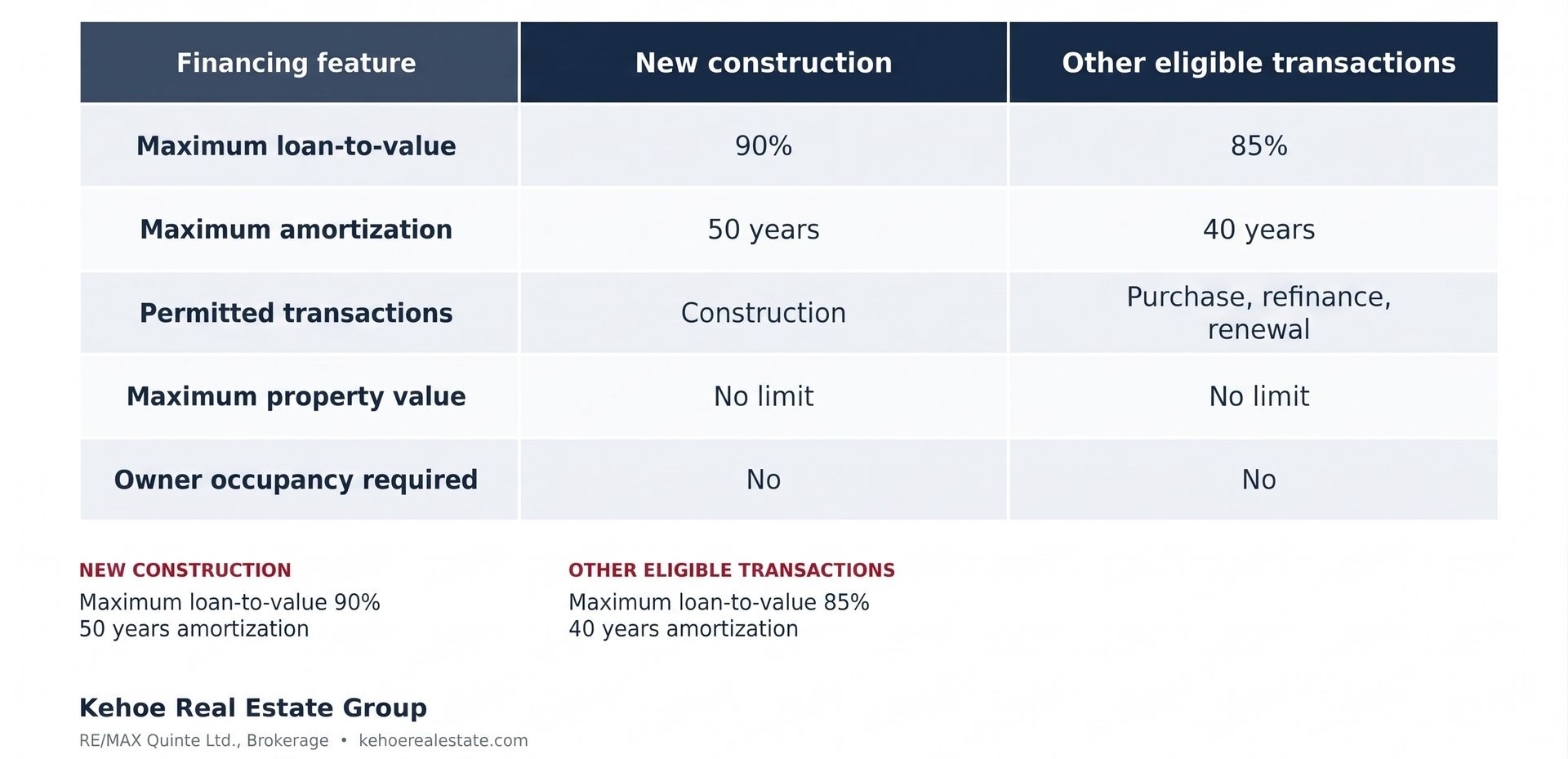
The program also includes financial qualification requirements, including minimum borrower net worth and debt coverage criteria. Separate underwriting requirements apply to construction financing.
What Could This Mean for Local Investors and Developers?
Financing is one of the largest challenges facing smaller residential developers. For many projects, the amount of capital required upfront can make a development difficult to pursue, even when the projected rental income supports its long-term operation. Improving access to insured financing could make certain smaller developments more financially viable.
This may be particularly relevant in Belleville and Quinte West, where opportunities exist for smaller infill developments and multi-residential housing. However, financing is only one component of development feasibility. Land acquisition costs, construction expenses, development charges, municipal approvals, zoning and achievable rental income will continue to determine whether individual projects make financial sense.
3. Nearly $45 Billion in Federal Housing Commitments
The largest housing announcement in the 2026 federal budget involves approximately $44.7 billion in proposed housing-related measures, on a cash basis, over eleven years.
The funding is intended to support affordable and non-market housing, increase construction activity and improve the efficiency of residential development. Several commitments stand out.
An Additional $13 Billion for Build Canada Homes
The government is proposing another $13 billion over ten years, beginning in 2028–29, to expand the capital available through Build Canada Homes. This initiative focuses heavily on affordable, supportive and non-market housing.
The government has identified a goal of delivering 200,000 homes through Build Canada Homes over the next decade.
$1.5 Billion to Prepare Federal Land for Housing
The budget proposes $1.5 billion over four years, beginning in 2027–28, to prepare federal properties for residential construction. This includes infrastructure such as roads, water and wastewater services.
The objective is to make underutilized federal land suitable for housing development and reduce some of the infrastructure costs that can prevent projects from proceeding.
The government is also proposing $100 million over three years, beginning in 2027–28, to help municipalities modernize building approval processes. This includes digital permitting systems and artificial intelligence intended to reduce processing times and improve efficiency.
Long municipal approval timelines can add substantial costs to development projects, particularly when construction financing and carrying costs are involved. Streamlining these processes could help reduce unnecessary delays, although the actual results will depend on municipal implementation.
Will the Funding Increase Housing Construction?
The government is clearly attempting to address several long-term obstacles to increasing housing supply. However, funding announcements do not automatically translate into completed homes.
Housing construction will continue to depend on economic conditions, infrastructure capacity, construction costs, labour availability and market demand. It will likely take several years before the full effects of these programs become apparent.
$100 Million to Accelerate Municipal Permitting
What About the Previously Announced Mortgage and HST Changes?
Some of the housing measures discussed in connection with the 2026 budget were introduced before this announcement.
For example, the federal government increased the insured mortgage property price cap from $1 million to $1.5 million effective December 15, 2024.
At the same time, 30-year insured mortgage amortizations became more widely available to first-time homebuyers and purchasers of newly constructed homes.
The 2026 budget proposes extending comparable provisions to optional mortgage insurance, which is a separate category from mandatory high-ratio mortgage insurance. Additionally, previously announced federal and Ontario tax relief programs provide substantial GST/HST savings for eligible purchasers of newly constructed homes.
These measures remain relevant to housing affordability and new construction demand, but they should not be confused with entirely new initiatives introduced in November 2026.
What Does This Mean for Belleville, Quinte West and Prince Edward County?
The biggest takeaway from Canada's 2026 federal budget is that the government is concentrating much of its attention on increasing housing supply rather than directly stimulating transactions in the existing resale market.
This distinction is particularly important for smaller regional markets. Across Belleville, Quinte West and Prince Edward County, housing market conditions have been influenced by buyer confidence, affordability concerns, borrowing costs and broader economic uncertainty. Unlike some of Canada's larger urban centres, the local housing market is not necessarily experiencing the same degree of supply pressure that characterized the market during the pandemic.
Increased housing construction may provide longer-term benefits, but it does not directly address every challenge currently affecting resale activity. The most relevant announcements for our region may be the expanded financing options for smaller multi-residential properties, particularly where new development can be supported by local rental demand.
Meanwhile, the proposed foreign buyer exemption will likely be more significant in larger Canadian urban centres than in the Bay of Quinte region.
Our Assessment: A Long-Term Supply Strategy, Not Short-Term Market Stimulus
The 2026 federal budget includes several potentially meaningful measures to encourage housing development. Opening the new construction market to foreign investment, improving financing options for smaller residential developments and investing billions of dollars in housing infrastructure could help support construction activity over time. However, the budget provides relatively little immediate assistance to the existing resale market.
For buyers and sellers in Belleville, Quinte West and Prince Edward County, factors such as mortgage rates, household affordability, local inventory and economic confidence are likely to remain more influential in determining market conditions.
Ultimately, the success of these initiatives should be measured by how much additional housing is actually constructed, rather than the total amount of funding announced.
Sources
- Government of Canada — Federal Budget 2026, Chapter 3
- Department of Finance — Mortgage Insurance Changes for Missing Middle Housing
- Australian Government — Foreign Investment in Residential Land
- Department of Finance — Mortgage Reforms Effective December 15, 2024
Information current as of November 17, 2026. Some federal measures remain proposals and are subject to legislation, regulations and implementation requirements.